
Vitamin D plays a crucial role in our health, influencing everything from bone density to immune strength. While dietary supplements and fortified foods can help, the primary source of vitamin D for most people is sunlight — specifically, UVB radiation that stimulates vitamin D3 production in the skin. But not all sunlight is equal, and our ability to use it changes based on geography, time of year, time of day, skin type, and age.
Two Australian cities — Melbourne (latitude ~37.8°S) and Surfers Paradise on the Gold Coast (latitude ~28.0°S) — offer excellent examples of how sunlight varies and what this means for vitamin D synthesis. To illustrate this, we analysed UV Index data and created heatmaps that show when sun exposure is most effective for generating vitamin D.
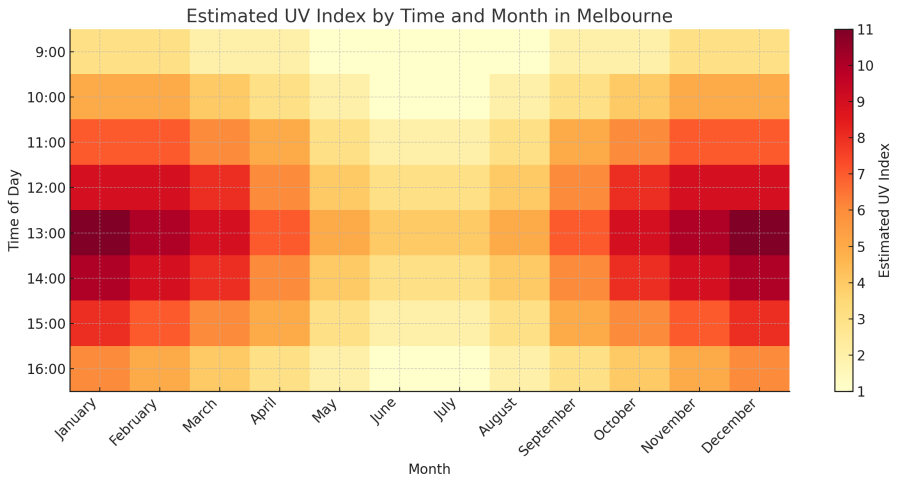
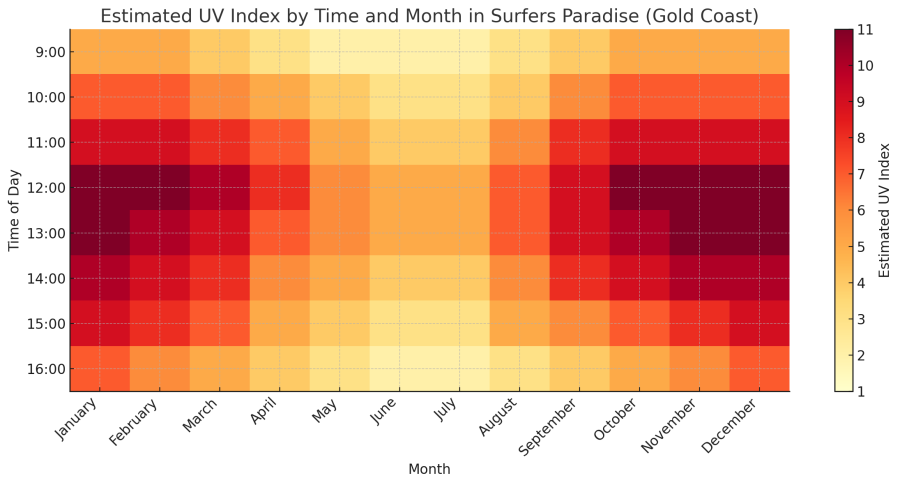
The UV Index is a standardised scale measuring the intensity of ultraviolet radiation. For vitamin D synthesis, a UV Index of at least 3 is required. Below that threshold, the body cannot produce meaningful levels of vitamin D. Interestingly, the ability to make vitamin D declines with age — not because of melanin (as commonly believed), but because the skin’s levels of 7-dehydrocholesterol, the raw material for vitamin D, decline sharply with age. Research shows that a 70-year-old produces only about 25% of the vitamin D that a 20-year-old can, even with the same sun exposure.
The following two heatmaps show the estimated UV Index throughout the year in Melbourne and Surfers Paradise, broken down by hour of the day and month. These visualise the UV intensity between 9:00 AM and 4:00 PM for each month of the year.
In Melbourne, UVB radiation is seasonally limited — falling below the required threshold during much of autumn and winter. In contrast, the Gold Coast retains ample UV exposure across nearly the entire year, even during winter months.
However, it’s not just the UV Index that matters — it’s also how much skin is exposed and for how long. For people with mid-dark skin tones (such as those of Italian or Mediterranean heritage), it takes longer to synthesise vitamin D due to the higher melanin content in the skin, which filters UVB radiation. For these individuals, exposing arms and legs (~35–40% of body surface area) requires 25–45 minutes of sunlight, while swimwear-level exposure (~90%) can be effective in just 10–20 minutes, assuming a UV Index of 3 or higher.
The next two heatmaps overlay these thresholds onto the UV Index data. In these charts, blue areas indicate periods where swimwear exposure is enough for vitamin D synthesis, while green areas show the shorter but more efficient windows for arms and legs exposure.
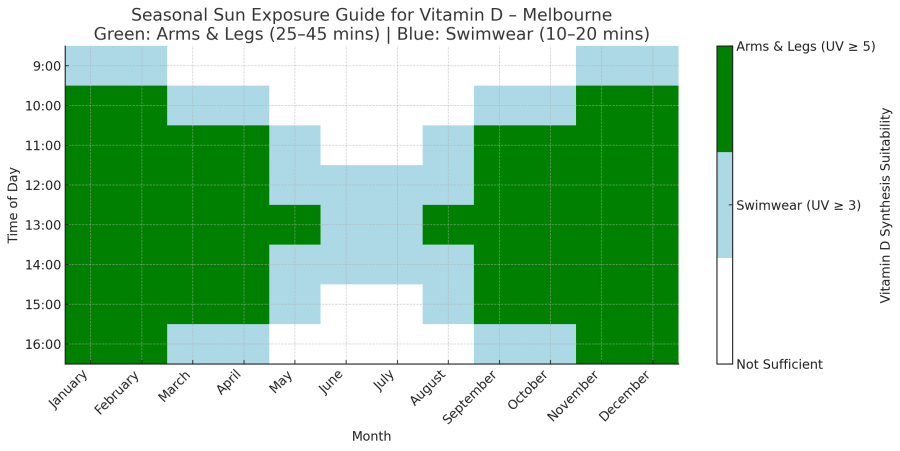
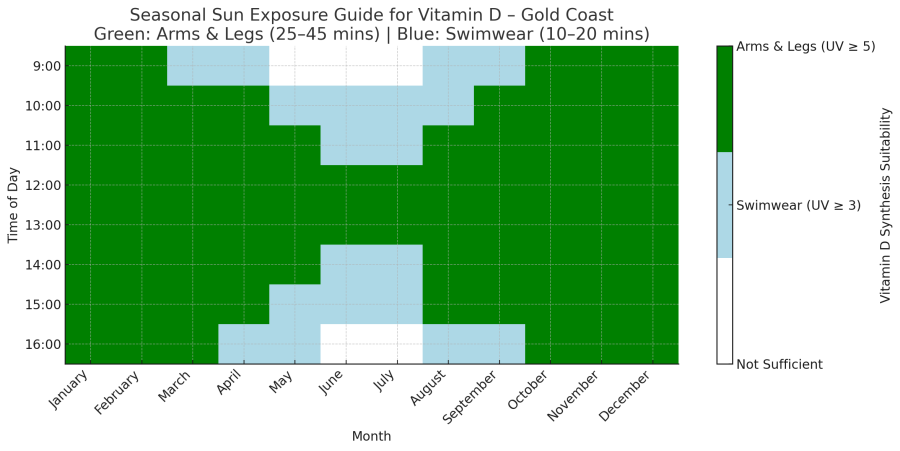
These visual guides make it easy to identify the best times of year and day to naturally support your vitamin D levels while avoiding overexposure. Melbourne residents will find optimal conditions mostly in spring and summer, while Gold Coast residents have a broader window, with year-round opportunities to meet vitamin D needs through short sun exposure.
These insights also apply globally. Melbourne’s latitude (~38°S) is comparable to cities like San Francisco (USA), Athens (Greece), and Buenos Aires (Argentina). The Gold Coast (~28°S) aligns more closely with Cairo (Egypt), Houston (USA), and Brisbane (Australia). People in these regions can use similar UV-based planning — just flipping the seasons for northern versus southern hemisphere.
Ultimately, the takeaway is clear: thoughtful sun exposure, matched to your skin type and season, can be a powerful tool to support vitamin D health. And while vitamin D supplements can help, they may not offer the full physiological benefits that come from natural, UV-driven synthesis. These heatmaps serve as a practical reference to time your exposure safely and effectively.